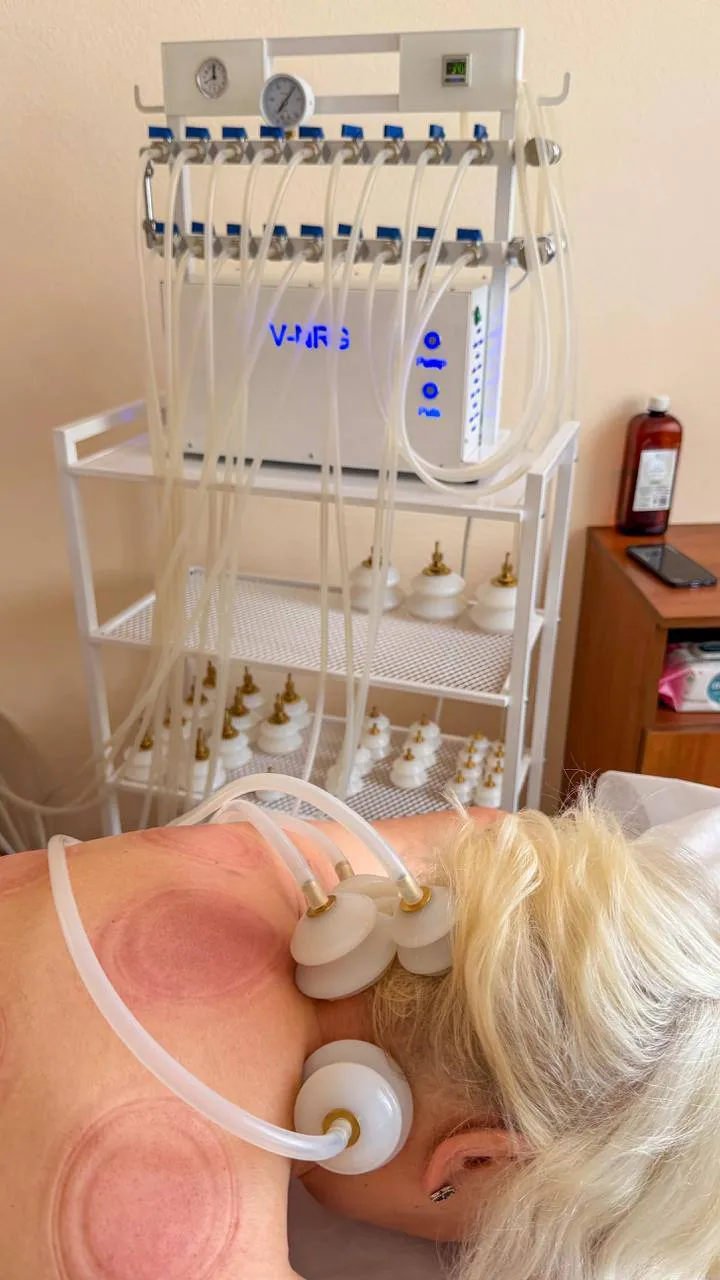
When Olympic swimmers first appeared on camera covered in round purple circles, half the world wondered what had happened to them. The answer was ordinary vacuum cupping — a massage technique physiotherapists have been using for decades. The method looks simple, but its mechanics are the opposite of what most people expect: instead of pressing on the tissues, it pulls them upward.
Let’s break down how cupping massage works, which back and muscle problems it helps with, where those famous marks come from — and who must avoid the procedure.
What Is Vacuum Cupping and How Is It Different From Regular Massage?
Vacuum (cupping) massage treats soft tissues with localized negative pressure. Cups are placed on the skin and the air inside them is rarefied: the tissue is drawn up into the cup, and the therapist either leaves the cups in place (static technique) or glides them along massage lines (dynamic technique).
The key difference from classic massage is the direction of force:
- classic massage compresses the tissues, kneading them from above;
- vacuum massage lifts and stretches the skin, subcutaneous layer, fascia and superficial muscles.
That is why cups reach where hands struggle to: deep tight spots, “glued” fascial layers and congested zones that respond poorly to ordinary kneading. The two methods are often combined — classic massage warms the tissues up, and cupping then works through the problem areas.
What Happens in the Tissues Under the Cup
The pressure under the cup is lower than atmospheric, and the tissues respond with several processes at once:
- blood flow increases — arterial blood rushes to the area, bringing oxygen and nutrients;
- lymph drainage activates, reducing congestion and puffiness;
- fascia stretches — the connective-tissue sheaths around muscles, which “stick together” under chronic tension and restrict movement;
- tight muscles relax — a reflex response to deep stretching;
- local metabolism speeds up in the skin and underlying tissue.
In essence, vacuum massage forces a “reboot” of the local blood supply. Typical sensations after a session are warmth in the treated area, easier movement and less stiffness.
Back and Muscle Problems Cupping Is Used For
Most often, vacuum massage is prescribed for muscular and congestion-related back problems:
- back and neck pain or stiffness from long hours at a desk or behind the wheel;
- muscle knots and trigger points — painful tight bands within a muscle;
- myofascial pain syndrome;
- muscle recovery after workouts and physical exertion;
- osteochondrosis and chronic back tension — as part of complex therapy, outside of flare-ups;
- general muscle hypertonicity caused by stress.
There is also a cosmetic side: cupping is widely used to improve skin tone and reduce cellulite, since boosted blood and lymph circulation works there too.
One honest caveat: cups relieve the muscular component of pain, but they do not treat its root cause if that cause lies deeper — in the spine, joints or internal organs. Persistent back pain calls for diagnosis first, massage second.
Why Cupping Leaves Marks — and Whether That Is Dangerous
This is the most googled question about the procedure, and the answer is reassuring: cupping marks are not bruises from trauma.
Under negative pressure, the walls of the finest vessels — the capillaries — let a small amount of blood seep into the surrounding tissue. This creates the characteristic round spots:
- they are usually painless, unlike a real bruise;
- their color reflects the state of the tissue — from light pink to deep crimson in heavily congested zones;
- they fade on their own within a few days, gradually lightening.
Experienced therapists even read these marks: the darker the spot, the more congested the area was. With each following session the marks typically become fainter as local circulation improves.
The only reasons for concern are marks that are sharply painful, blistered or unusually slow to fade — mention these to your specialist.
Contraindications: Who Should Not Have Vacuum Massage
Cupping puts intense stress on the vessels and skin, so the list of contraindications is a serious one:
- skin diseases, rashes, wounds or any damage in the treatment area;
- varicose veins — cups are never placed over affected veins;
- bleeding disorders, fragile capillaries, anticoagulant therapy;
- thrombosis and thrombophlebitis;
- fever and acute infectious diseases;
- oncological diseases;
- severe cardiovascular conditions and hypertensive crises;
- pregnancy — especially the back, lower back and abdomen;
- active tuberculosis.
Cups are also never placed on protruding moles, directly on the spine, or over the heart and kidney areas — these are standard safety rules of the procedure.
The final decision on whether you can have the massage is made by the center’s doctor after an examination. If you have any chronic conditions, tell the specialist about them before the session begins.
Cupping Massage in Kyiv: What a Session Is Like and How to Book
The session itself is straightforward: you lie on a massage table, the specialist applies oil to the skin, places the cups and works in the chosen technique — static or dynamic. You should feel deep stretching and warmth; pain is not normal, so speak up about any discomfort right away.
At the RUTA Medical and Health Center, vacuum cupping massage is available as a standalone service. The center operates on the grounds of the Koncha-Zaspa sanatorium at 215 Stolychne Highway, Kyiv, under a license of the Ministry of Health of Ukraine (series AB No. 567785, issued 11.11.2010). The procedure can also be combined with the center’s other health programs — read about the five-day course and see current rates on the prices page.
Call us — we will answer your questions and find a convenient time:
Give your back its lightness back — muscles know how to say thank you.
This article is for information only and does not replace a medical consultation. The decision to undergo the procedure is made by a doctor after an examination.
This article is for information only and does not replace a consultation with a doctor.