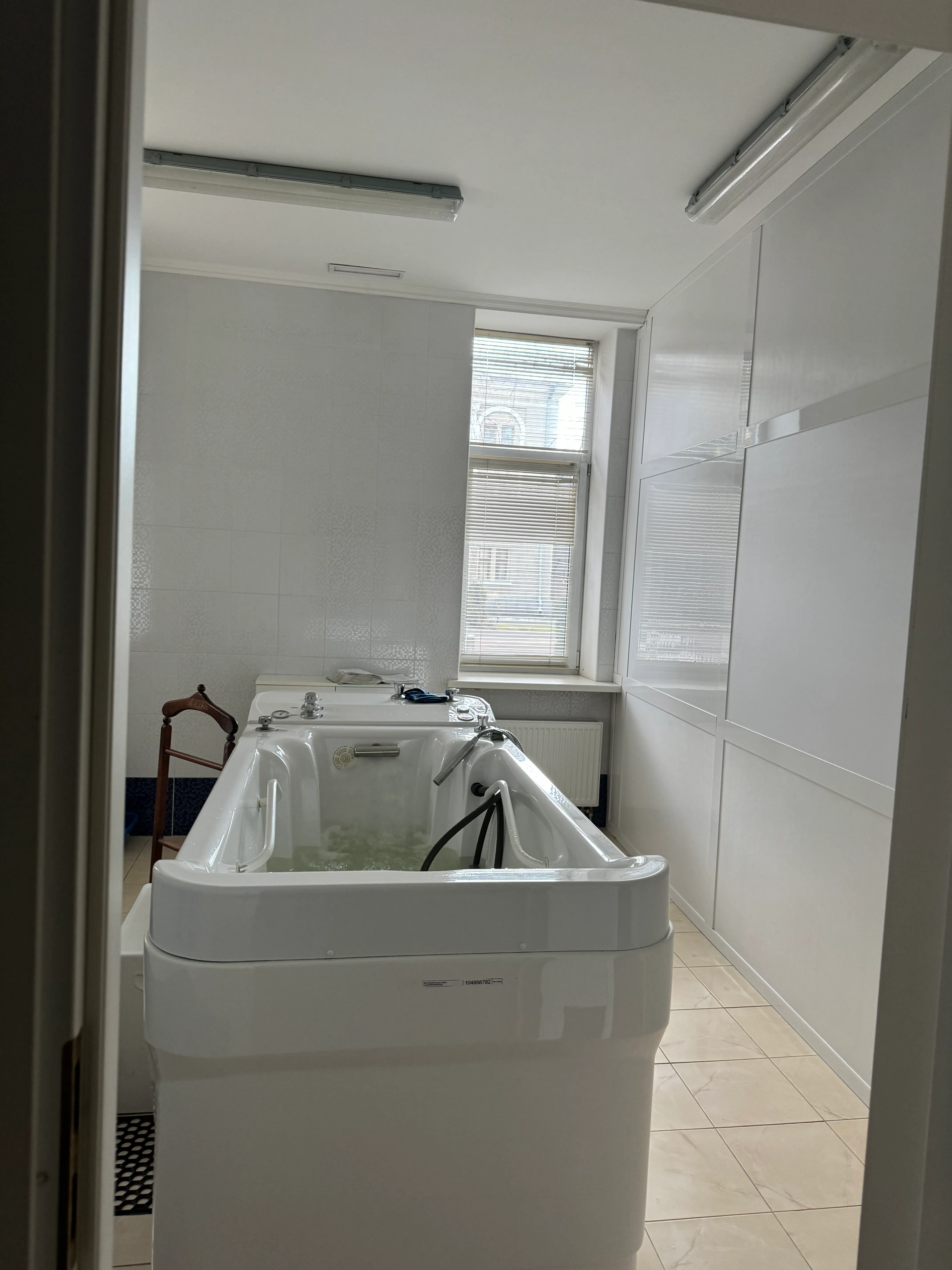
A warm bath relaxes on its own — anyone who has sunk into hot water after a long day knows the feeling. Now add a controlled jet of water that kneads the muscles of your back, legs and shoulders while you simply lie there. That is underwater massage (also called underwater jet massage or hydromassage in a bath) — one of the classic hydrotherapy treatments used for decades in physiotherapy and spa medicine across Europe.
Here is how the procedure works, what benefits it offers, who it is recommended for — and, just as importantly, who should avoid it.
What Is Underwater Massage and How Does It Work
Underwater massage combines a warm therapeutic bath with a massage performed by a pressurized water jet. You lie in a bath filled with comfortably warm water, and a specialist guides a jet through a hose beneath the surface, moving it along the massage lines of the body.
Three factors work on the body at the same time:
- the warmth of the water relaxes muscles, dilates skin vessels and relieves spasm;
- hydrostatic pressure gently “hugs” the body, supporting venous return and lymph flow;
- the mechanical action of the jet kneads muscles and soft tissues much like a massage therapist’s hands — but deeper and, paradoxically, more gently.
The key difference from manual massage is that the body is already relaxed by the warm water. Muscles do not resist, so the jet can reach deep layers that are hard to work by hand — without pain or bruising.
The therapist controls the intensity by adjusting the jet’s pressure, its distance from the body and the angle of impact — from a light stroking effect to deep kneading.
Benefits of Underwater Jet Massage
Underwater massage is a treatment with a systemic effect: it works not only on muscles but also on circulation, the lymphatic system and nervous regulation.
The main effects described in physiotherapy practice:
- muscle relaxation — tension and spasm are relieved, especially in the back, neck and lower back;
- improved blood circulation — tissues receive more oxygen and metabolic processes speed up;
- lymphatic drainage — swelling and fluid retention decrease;
- toning of the skin and subcutaneous tissue — one reason the treatment is popular in anti-cellulite and body-contouring programs;
- a calming effect on the nervous system — better sleep, lower stress levels;
- general recovery — after a course, most people report feeling lighter and more energetic.
None of this is “water magic” — it is a predictable physiological response to the combination of warmth, pressure and mechanical stimulation.
What Conditions Underwater Massage Helps With
In hydrotherapy, underwater massage is traditionally recommended for:
- muscle tension and back pain — from sedentary work or physical overload;
- chronic fatigue and asthenia — low energy, reduced performance, burnout states;
- stress and sleep disturbances — thanks to the sedative effect of warm water;
- poor circulation, swelling and congestion — the jet stimulates venous and lymphatic outflow;
- excess weight and cellulite — as part of comprehensive programs;
- low general tone — during recovery after illness (outside the acute phase);
- metabolic disorders — within broader wellness programs.
This list is indicative, not a prescription. Whether the treatment suits you, at what intensity and for what goal, is determined by a doctor after an examination and a conversation about your health.
What a Session Looks Like, Step by Step
For the guest, the procedure could hardly be simpler — your only task is to relax.
- Preparation. You settle into a bath of warm water and lie still for a few minutes while the body adapts and the muscles begin to release.
- The jet massage. The specialist takes the hose and guides the water jet beneath the surface along your body: back, legs, arms, shoulder area. The heart area and other sensitive zones are avoided.
- Adjusting the intensity. Pressure and distance are tailored to you: some areas need deep kneading, others a gentle sweep. If anything feels uncomfortable, just say so — the intensity will be reduced.
- Finishing. After the massage, take your time: rest quietly and let the body settle. Strenuous activity right after a session is not recommended.
Most people describe the sensation as a deep massage without pain, followed by pleasant heaviness and calm.
At the RUTA center, underwater massage is available as a standalone treatment — see the underwater massage service page for details. Water treatments are also part of the five-day inpatient cleansing course held at the Koncha-Zaspa sanatorium.
Contraindications: Who Should Avoid Hydromassage
Like any physiotherapy treatment, underwater massage has its limits. Typical contraindications include:
- acute inflammatory and infectious diseases, fever;
- cancer;
- decompensated cardiovascular disease, severe hypertension;
- thrombophlebitis and a tendency to thrombosis;
- skin infections or damaged skin in the treatment area;
- bleeding disorders;
- kidney stones or gallstones in the acute phase;
- pregnancy;
- epilepsy and certain neurological conditions.
This list is not exhaustive. The final decision on whether the procedure is right for you is made by the center’s doctor after an examination, taking into account your medical history and current condition. That is exactly why hydrotherapy should never be self-prescribed, however harmless it may seem.
Underwater Massage in Kyiv: How to Book
RUTA Medical and Health Center operates at the Koncha-Zaspa sanatorium: 215 Stolychne Highway, Kyiv. The center is licensed by the Ministry of Health of Ukraine (license AB No. 567785, issued 11.11.2010).
Underwater massage is available as a separate service — and if you are considering a comprehensive health program, see the course prices page: the inpatient course includes water treatments, massage, a swimming pool and medical tests.
Call us — we will answer your questions, advise on indications and help you choose a convenient time:
Let the water do its work — under professional supervision.
This article is for informational purposes only and does not replace a medical consultation. The decision to undergo the procedure is made after an examination by a specialist.
This article is for information only and does not replace a consultation with a doctor.